No products in the cart.
Military Service as a Mitigating Factor in Criminal Sentencing
 Marie Timariu
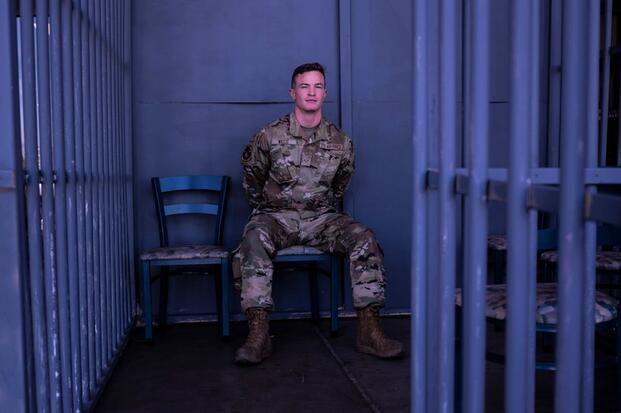
Airman 1st Class Chandler Willis, from the 355th Wing Maintenance Group, poses for a photo while serving his sentence for a Jail n’ Bail event during National Police Week at Davis-Monthan Air Force Base, Arizona. US Air Force photo by Senior Airman Kaitlyn Ergish. Source: DVIDS. Military.com | By Haley Fuller Published April 24, 2026 at 3:00am ET Military service once operated, in practice, as an alternative to incarceration in the United States, particularly during wartime periods when enlistment could take the place of traditional punishment. That practice largely disappeared by the late twentieth century as sentencing became formalized under statutes like the Sentencing Reform Act of 1984, which imposed structured, guideline-based punishment, and as the military adopted stricter enlistment standards that limit the acceptance of individuals with criminal records.
What has developed instead is a narrower but consequential practice: courts and legislatures increasingly treat prior military service as a mitigating factor that can reduce the length or severity of a sentence. This shift operates through federal judicial discretion, state statutes, and specialized diversion programs, and it reflects an effort to individualize punishment based on a defendant’s background.
At the federal level, this development stems from the Supreme Court’s decision in United States v. Booker, which made the Federal Sentencing Guidelines advisory rather than mandatory. That change allows judges to consider personal history, including military service, when determining a sentence.
Empirical evidence shows that this discretion produces measurable reductions in sentence length. The United States Sentencing Commission found that 38.9% of veteran defendants received sentences below the guideline range, compared to around 31% of civilian offenders. Courts specifically cited an offender’s military service as a reason for the sentence imposed in 15% of cases involving veteran offenders. This indicates that courts sometimes impose shorter sentences for veterans than the guidelines recommend.
Courts often justify these reductions by examining whether military service affected culpability. Judges often consider exposure to combat, post-traumatic stress disorder (PTSD), traumatic brain injury (TBI), or substance abuse linked to service. These factors can reduce perceived blameworthiness if they contributed to the offense. This approach aligns with the statutory requirement that sentences be “sufficient, but not greater than necessary,” codified at 18 U.S.C. § 3553(a).
Continue reading the full article →
Source: Military.com
Website: www.military.com